

10 Sustainable Home Decor Ideas Using Natural Jute
Here’s something the interior design world has quietly known for years but is only now saying out loud: the most beautiful rooms are almost never the most expensive ones. They are the most honest ones. Rooms where the materials make sense. Where nothing is pretending to be something it isn’t. Where you can run your hand across a surface and feel that it came from somewhere real.
Natural jute has been creating those rooms for centuries. And right now — in an era where people are increasingly done with fast furniture, synthetic fills, and disposable decor — it is having exactly the cultural moment it deserves.
Whether you are starting a full room refresh or simply looking for one piece that changes the feel of a space, this guide will show you ten ways to bring jute into your home — with specific styling tips for each one, so you actually know what to do with the ideas rather than just feeling inspired and then doing nothing.
Why Jute Is the Defining Material of Conscious Interiors Right Now
Before we get into the ideas, it is worth understanding why jute specifically — and not just “natural materials” in general — is the one designers and conscious homemakers keep coming back to.
Jute has a warmth that linen doesn’t quite replicate. It has a structural quality that cotton lacks. It is more affordable than rattan and more sustainable than most wood products. It photographs beautifully — the warm golden-brown tone works with almost every color palette — and it ages gracefully, developing a softer, more characterful texture over time rather than looking worn out.
It is also, at its core, deeply honest. Jute is what it looks like. There is no coating, no synthetic treatment, no attempt to be something other than a natural plant fiber shaped by human hands into something useful and beautiful.
In a world of surfaces pretending to be other surfaces, that honesty is rare. And it shows in a room.
Idea 1: Anchor Your Living Room With a Natural Jute Rug
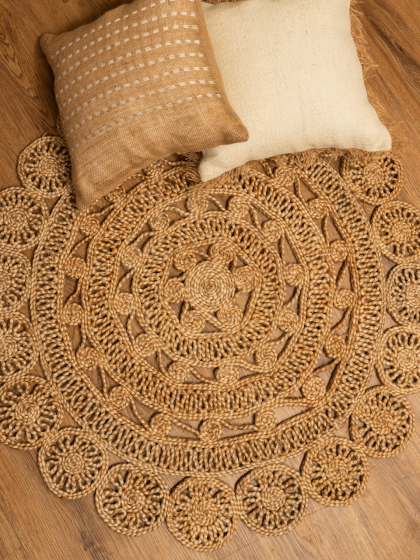
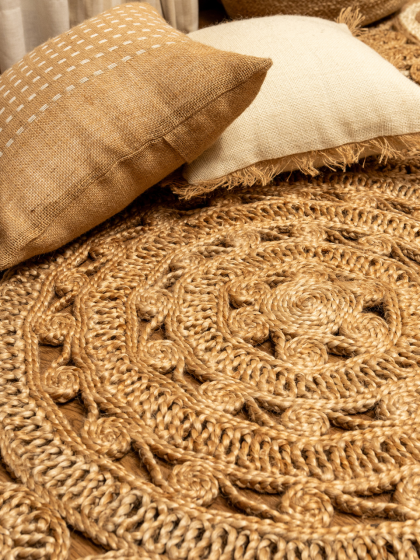
If there is one single change you can make that will transform the feel of a living room more than any other, it is laying down the right rug. And for a natural, grounded, effortlessly beautiful result, nothing beats a handwoven jute rug.
A jute rug does something very specific in a space: it anchors it. It defines where the seating area begins and ends. It brings warmth to hard floors — whether tile, wood, or concrete — without the visual heaviness of a dark synthetic rug. And in a room that feels busy or slightly chaotic, a jute rug introduces a note of calm that everything else organizes itself around.
Styling tips:
The most common mistake people make with jute rugs is going too small. A rug that sits only under the coffee table — with sofas and chairs floating beyond its edges — looks like an afterthought. Go larger than you think you need. Ideally, the front legs of all your seating should sit on the rug. This visually unifies the space and makes the room feel deliberately designed rather than randomly assembled.
For color pairing, jute’s natural golden-brown tone works beautifully with warm whites, terracotta, sage green, dusty pink, and deep navy. It is genuinely difficult to find a palette it clashes with — which makes it one of the most versatile foundational pieces in interior design.
If your room already has a lot of visual texture — patterned cushions, busy artwork, layered shelving — choose an undyed natural jute rug in a simple weave. Let it be the quiet base that lets everything else breathe. If your room is more minimal, a jute rug with a subtle geometric border or contrasting edge detail adds just enough interest without overwhelming the space.
Idea 2: Use Woven Jute Baskets as Styled Storage
Storage is one of the great unsolved problems of modern homes. We accumulate things — blankets, toys, magazines, remote controls, charging cables, the inexplicable objects that appear from nowhere and need to live somewhere — and we need places to put them. The standard solution is plastic bins and cardboard boxes, which solve the practical problem while creating an aesthetic one.
Jute baskets solve both problems at the same time.
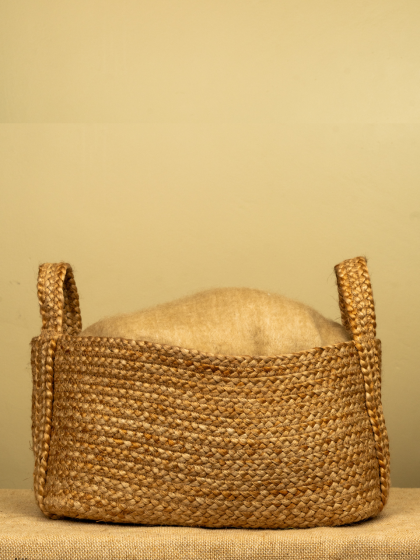
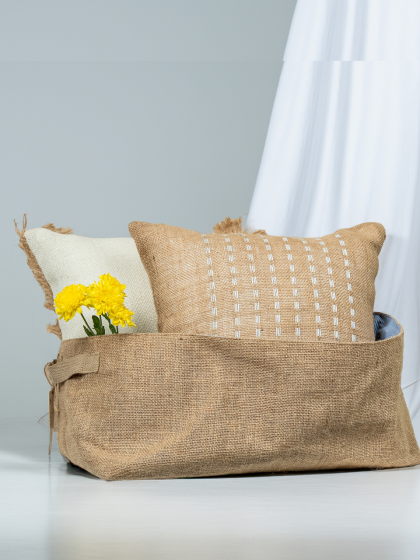
A well-made jute basket holds things efficiently and looks genuinely beautiful doing it. It does not try to hide in a cupboard. It can sit on your coffee table, your bookshelf, on the floor next to your sofa, or in a corner of a bedroom — and in every one of those locations, it adds to the room rather than detracting from it.
Styling tips:
Group baskets in odd numbers — three or five — when placing them together. Odd groupings feel more natural and less arranged than even ones. Vary the heights and sizes if you are grouping multiple baskets in one area.
Use your baskets intentionally: a large round basket beside the sofa for throw blankets, a medium rectangular basket on a shelf for books and magazines, a small oval basket on a side table for remotes and small accessories. When storage has a visual logic to it, the whole room feels more considered.
Leave the top of the basket slightly open rather than over-stuffing it. A basket that is pleasingly full — with perhaps one corner of a folded blanket visible — looks styled. A basket that is bulging and overfull looks like a problem that hasn’t been dealt with.
Idea 3: Transform Your Dining Table With Jute Table Runners and Mats
The dining table is one of the most frequently used surfaces in a home and one of the most frequently neglected when it comes to styling. A bare wooden table is fine. A table with a jute runner down the center is something else entirely.
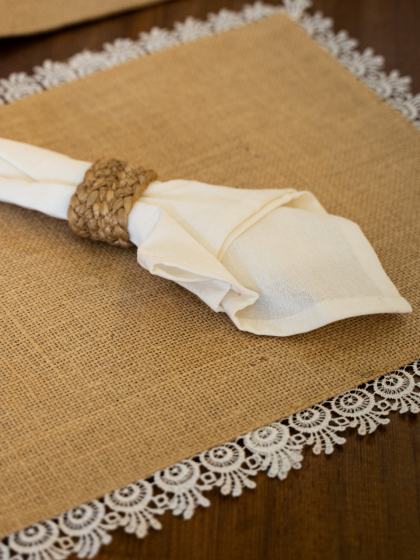
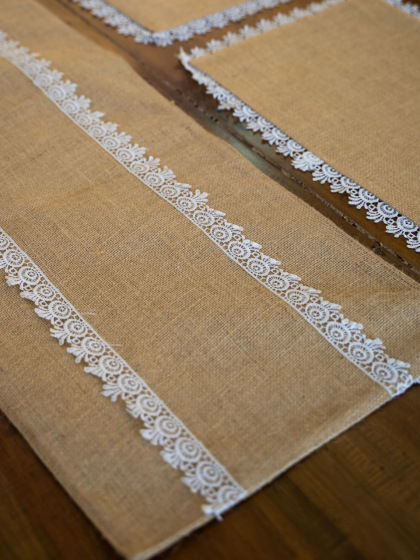
A table runner is the simplest possible way to make a dining table feel intentional. It gives the table a spine — a visual anchor that everything else (candles, a vase, a bowl of fruit) organizes itself around. And a natural jute runner does this while adding texture, warmth, and a material story to a space that often has none.
Paired with individual jute placemats or coasters, the effect is a table that looks like it has been styled — not because it is elaborate or expensive, but because it is considered.
Styling tips:
A table runner should hang approximately 15 to 30 centimetres off each end of the table. Too short and it looks like a mistake. Too long and it looks like a tablecloth that didn’t make it all the way.
Layer your runner over a plain linen tablecloth in a complementary tone — warm white, natural oatmeal, or a soft sage — for a more layered, textured look. On its own against bare wood, a jute runner works best on tables with warm wood tones. On darker wood or lacquered surfaces, the contrast can look very striking.
For everyday styling, keep the table runner and mats simple and let a single central element — a low ceramic vase, a cluster of small candles, a bowl of seasonal fruit — do the decorative work. The jute is the foundation; it doesn’t need help.
Idea 4: Bring Warmth to a Bedroom Corner With a Jute Floor Basket
Bedrooms accumulate things: extra pillows, seasonal blankets, books you are currently reading, the clothes you wore yesterday and haven’t decided whether they are clean or dirty. Most of these things end up on a chair — the universal resting place of bedroom clutter.
A large jute basket placed deliberately in a corner of the bedroom is a more elegant solution. It holds the extra throw blankets you pull out in winter. It houses the books waiting to be read. It gives the room a sense of organization without the coldness of a storage unit.
Styling tips:
In a bedroom, texture is everything. Jute works particularly well against soft furnishings — linen bedding, a velvet headboard, a chunky knit throw. The rough, natural quality of jute alongside soft, smooth, or plush textures creates a sensory layering that makes a room feel genuinely comfortable rather than just decorated.
Place a large round jute basket in a corner near the window or beside the bed. Keep it fairly full — a folded blanket visible at the top, perhaps a paperback or two leaning against the inside edge. A basket that looks used feels intentional. An empty basket in a corner just looks forgotten.
Idea 5: Style a Bookshelf With Small Jute Baskets
Open shelving and bookcases create a particular interior design challenge: they look great in magazine photographs and chaotic in real life. Books are different heights. Objects accumulate. The result is usually a shelf that looks like a storage unit rather than a designed feature.
Small jute baskets solve this problem more elegantly than almost any other styling device. Placed at the end of a shelf, or used to break up a run of books, they introduce organic texture and visual rest into what is otherwise a very busy surface. They also provide actual storage for the small items — chargers, spare keys, little objects that have no home — that would otherwise make the shelf look cluttered.
Styling tips:
Use small jute baskets as bookends on either side of a shelf section. Stack two or three books horizontally, lean a framed print against them, and place a small basket at the end. This immediately elevates a single shelf from “storage” to “styled.”
Limit your styling objects per shelf to three or four items maximum. Books, one or two decorative objects, and a small jute basket is a reliable combination that almost always works. Resist the urge to fill every centimetre of space — negative space on a shelf is what makes the things you have placed there look intentional.
Idea 6: Create a Layered Entryway With Jute
The entryway is the first thing people see when they come into your home and the last thing they see when they leave. It sets the tone for the entire space — and yet it is almost universally neglected.
Jute is ideal for entryways for both practical and aesthetic reasons. Practically, jute rugs and mats are robust enough to handle high foot traffic and are good at trapping dirt and debris from shoes. Aesthetically, the natural warmth of jute creates an immediate sense of welcome — something no synthetic doormat has ever managed.
Styling tips:
Layer a jute rug over a slightly larger natural fiber or plain rug if your entryway is big enough to support it. This layered look adds depth and visual interest to a small space without overwhelming it.
Add a tall jute basket beside the entrance for umbrellas, walking sticks, or rolled-up bags. Keep a smaller basket on a shelf or console for keys, sunglasses, and the small daily carry items that otherwise end up scattered everywhere. An entryway that has a place for everything feels calm even when life doesn’t.
Idea 7: Use Jute Lighting to Create Ambient Warmth
Most rooms are lit for function — bright enough to see, positioned to illuminate work surfaces and reading areas. Very few rooms are lit for feeling. And yet the quality and warmth of light is one of the single biggest factors in how a room feels to be in.
Jute pendant lights and lampshades are one of the most effective ways to change the emotional quality of light in a space. The natural fiber softens and diffuses light as it passes through it, creating a warm, slightly dappled glow that is the indoor equivalent of afternoon sunlight through leaves.
Styling tips:
A jute pendant light works beautifully in a dining area hung low over the table — approximately 70 to 80 centimetres above the surface. At this height it creates an intimate pool of warm light that makes the table feel like the center of the room.
In a living room or bedroom, a jute lampshade on a floor lamp or side table lamp creates a warm, golden tone that makes the room feel instinctively cozy. Pair it with warm-toned bulbs (2700K or lower) rather than cool-white bulbs, which will work against the natural warmth of the jute.
Idea 8: Style Your Kitchen With Jute Coasters and Trivets
The kitchen is a room that often gets left out of conversations about natural home decor — it feels too functional, too tiled, too much about practicality to benefit from something as considered as styling.
This is a missed opportunity.
Jute coasters, trivets, and small round mats bring exactly the same warmth and texture to a kitchen countertop or dining nook that they bring to a living room or dining table. They are also genuinely practical — protecting surfaces from heat and moisture — which means they earn their place twice over.
Styling tips:
Stack three or four jute coasters beside your kettle or coffee machine. They look good as a small stack and they are immediately at hand when you need them. This is the kind of tiny detail that makes a kitchen feel thoughtfully put together rather than purely functional.
A round jute mat under a wooden cutting board, a fruit bowl, or a mortar and pestle creates a small moment of natural texture on a countertop that might otherwise be entirely hard and smooth. It takes thirty seconds to place and it genuinely changes the feeling of the surface.
Idea 9: Add a Jute Tote as a Functional Decor Piece
This idea surprises people — using a bag as a decor element — but it is more natural than it sounds.
A beautiful jute tote hung on a hook in a hallway, draped over a chair in a bedroom, or placed open on a shelf in a home office is both a functional object and a visual one. When the bag itself is well-made and beautiful, it doesn’t need to be hidden away in a wardrobe. It can be part of the room.
Styling tips:
Hang a jute tote on a wall-mounted hook in your entryway as your designated “grab and go” bag — the one you take to the market, the gym, or a casual day out. Keeping it visible and accessible means you will actually use it, which means one less plastic bag every time you leave the house.
In a home office or creative workspace, a structured jute tote open on a shelf makes a striking and functional pen holder, plant pot cover, or storage piece for rolled-up prints and documents. The natural material adds warmth to what is often a cold, screen-dominated environment.
Idea 10: Build a Whole-Room Jute Palette
The individual ideas above are all powerful on their own. But the most transformative approach — and the one that creates the kind of room you see in design editorials and immediately want to live in — is to let jute become the material thread running through an entire space.
This doesn’t mean putting jute on every surface. It means choosing jute as your primary natural material and building the rest of the room’s palette and textures in conversation with it.
Styling tips:
Start with the largest piece — usually a rug — and let that anchor the room. Then add a basket or two for storage. A runner on the dining table. A pendant light overhead. Small coasters and mats on surfaces. By the time you have five or six jute elements in a room, the space has a coherence and warmth that individual pieces alone cannot create.
The color palette that works best alongside jute’s natural golden-brown is broadly what designers call “warm earth tones” — terracotta, burnt orange, warm white, sage green, dusty pink, clay, rust, and off-white. Cooler tones like grey, slate, and cool white work too, but they create a slightly more contemporary, pared-back feeling rather than the warm, organic feeling that most people are looking for when they turn to natural materials.
Layer in other natural materials alongside jute — raw wood, ceramic, linen, unglazed pottery, rattan — and the room begins to feel like it belongs to a particular point of view rather than just a collection of things.
That is, ultimately, what good interior design is. A point of view, expressed through the things you choose to live with.
Jute is a very good place to start.
The Styling Principle Underneath All of This
Every idea in this guide is an expression of a single underlying principle: that natural materials make rooms feel more human.
Not more expensive. Not more designed. More human.
When you walk into a room where the rug is natural fiber, the baskets are woven by hand, the light is warm and soft, and the surfaces have texture you can actually feel — something relaxes. The room doesn’t demand anything from you. It just makes you feel at home.
That is what jute does, in room after room, in home after home, across centuries of human habitation. It is not a trend. It is not a style. It is simply a very honest material doing what honest materials have always done.
Making a space feel like somewhere worth being.
Explore TheKosha’s Jute Home Collection
Ready to bring natural jute into your home? Browse TheKosha’s full range of handwoven rugs, baskets, table mats, runners, lighting, and bags — all made in Nepal from 100% natural jute fiber.
👉 Shop Home Goods | Shop Rugs & Carpets | Shop Baskets | Shop Table Mats & Runners
Need help choosing the right piece for your space? Contact us — we love helping people find what they are looking for.